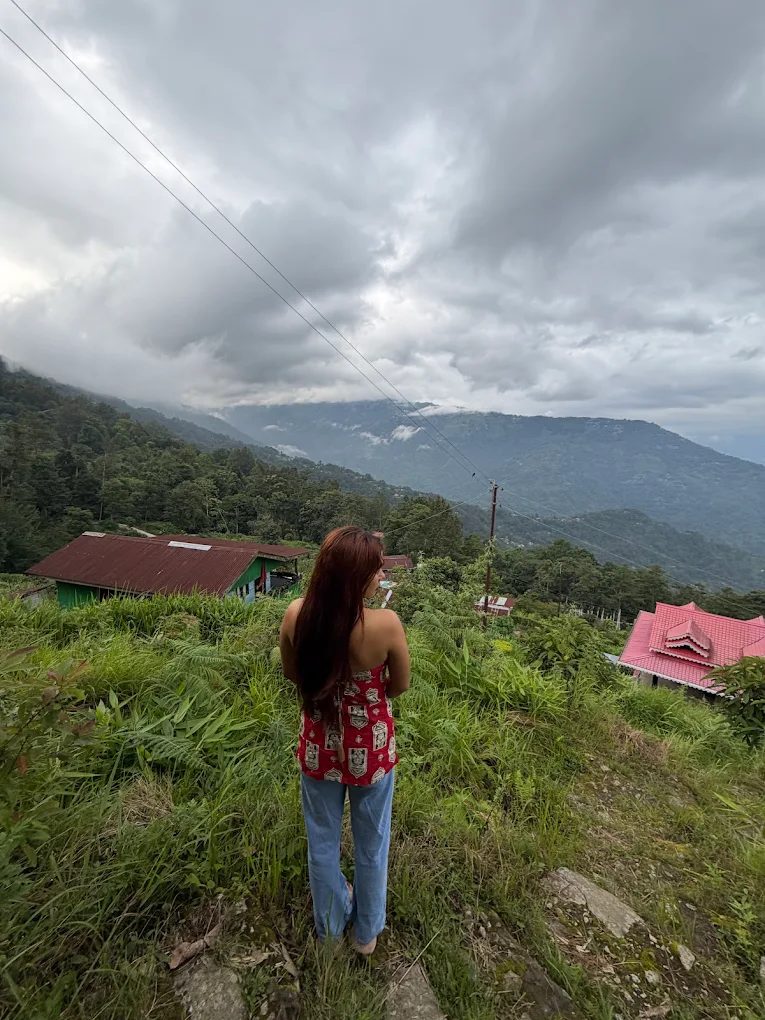
Kepchaki Stay is a family homestay in Rana Village, Lamahatta, with working organic fields around the house. The farming isn't an activity we invented for guests — it's how the household eats. Which means a farm stay here is simple: whatever the season is asking for, you're welcome to join. Sow, weed, harvest, or just walk the terraces with tea. Then eat what the fields gave, cooked in our kitchen the same day. It's included in the standard rate of ₹1,500 per person per night with all meals.
What a day looks like
There's no itinerary, because fields don't follow one. Mornings usually hold the real work — picking vegetables for the day's cooking, tending whatever's in the ground. A family member will call you when something is happening, and you do as much or as little as you like. An hour is typical. Some guests stay out all morning and come back with dirt under their nails and strong opinions about weeding.
The afternoon belongs to the porch, the eco park, or the walks — there are trails, viewpoints and a hidden waterfall ten minutes away. In the evening, dinner arrives and some of it was in the soil that morning. That's the entire trick of the place, and it doesn't get old.
What grows, by season
| Season | In the fields |
|---|---|
| Spring (Mar–May) | Sowing season — cucumber and corn going into the ground, and the bees at their busiest as the hills flower |
| Monsoon (Jun–Sep) | The fields at their greenest — cucumbers climbing, corn heading up, dalle chillies turning red |
| Autumn (Oct–Nov) | Harvest under the clearest skies of the year — corn, the last cucumbers and dalle picking, with Kanchenjunga watching |
| Winter (Dec–Feb) | Slower — field preparation, and more time for walks and the kitchen |
The bees and the dalle
Two things set our fields apart. The first is our Himalayan honey bee homes — traditional hives kept the way hill families have kept them for generations. Guests can watch the hives at work from a respectful distance, and when there's honey, you taste it raw — nothing between the comb and the spoon.
The second is dalle khursani, the small round fire chilli the Darjeeling and Sikkim hills are famous for — among the hottest chillies grown anywhere. Ours ripen red through monsoon and autumn. Try one whole at your own risk; most guests settle for a little on the side of dinner and a photo of the plant.
From the field to the plate
Everything the fields produce goes through our kitchen — dal bhat, seasonal saag, the cucumbers you picked, dalle on the side for the brave, and raw honey from our own hives. Guests who want to follow the food all the way can join the cooking too, and momo-making sessions are part of our packages. If you've only eaten "organic" from a supermarket shelf, eating it forty metres from where it grew is a different conversation.
Who a farm stay suits
- Families with children — pulling a vegetable out of the ground and eating it at dinner beats most screens. The fields are beside the house, so small children stay within sight.
- City guests who want to do something, not just see things — an hour in the fields gives a trip texture that another viewpoint can't.
- Long-stay and workation guests — a standing morning invitation to the fields is a better routine than a gym. See the workation guide.
- Anyone curious about hill farming — terraced fields at 5,700 ft work differently from the plains, and the family has grown up working them.
The honest caveats
This is a real farm on a real hillside, not a petting zoo. Work depends on season and weather — some days the fields need nothing, and monsoon mornings can be wet. Wear shoes you don't mind muddying. And if you'd rather not lift a finger, that's fine too; the fields are just as good to sit beside.